Skill Depth Scoring
Having a skill and having the right depth of that skill are completely different qualifications. This is the dimension no ATS or keyword checker even attempts to measure.
Why Depth Matters More Than Presence
Most resume tools ask one question: "Does your resume contain the word Python?" That is keyword matching. It tells you nothing about whether your Python experience is appropriate for the role.
A job posting asking for "deep Python expertise for ML pipelines at scale" and a posting asking for "familiarity with Python" are asking for completely different people. The word Python appears in both. Keyword matching gives the same result for both. Skill depth scoring does not.
The keyword matching failure mode
If you list SQL at Level 2 but the role requires Level 4, keyword matching tells you "you have SQL, you are a match." Depth scoring tells you "you have SQL but the role requires two levels of depth above what you have. This gap will likely come up in your first technical screen." That is the difference between a useful tool and a misleading one.
Level Profiles With Examples
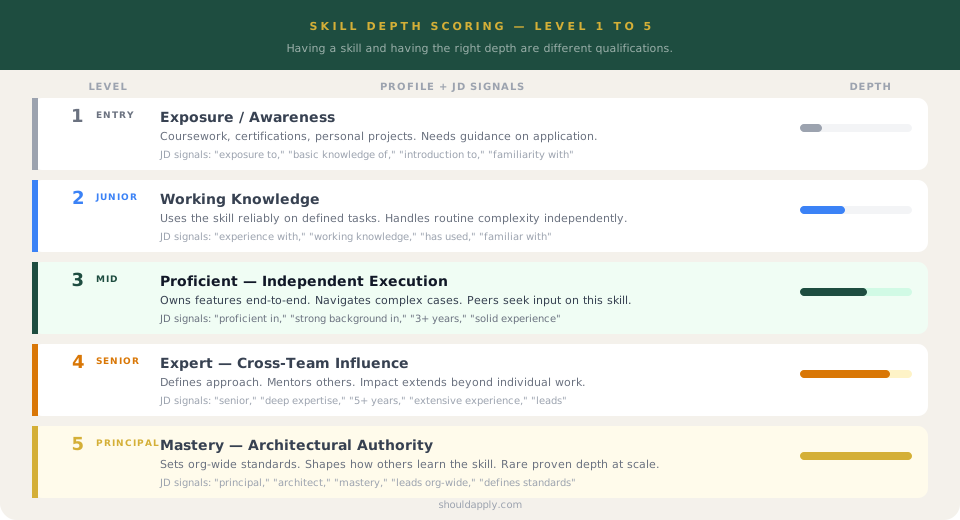
Each level maps to a consistent set of profile characteristics, years-of-experience ranges, and the language job descriptions use to signal it. SQL is used as the example skill across all five levels for clarity.
Coursework, certifications, side projects. Knows what the skill is and can apply it in simple contexts with guidance.
"familiarity with""exposure to""introduction to""basic knowledge of"SQL Level 1: Can write basic SELECT queries. Understands tables and joins conceptually.
Uses the skill reliably on defined tasks. Handles routine complexity independently. Still needs guidance on novel problems.
"working knowledge""experience with""comfortable with""2+ years"SQL Level 2: Writes multi-table joins, subqueries, and aggregations. Can optimize simple queries.
Owns deliverables end-to-end. Navigates ambiguous requirements. Peers consult on this skill. Handles complex cases without escalating.
"proficient in""strong background in""3+ years of""solid experience"SQL Level 3: Query optimization, window functions, stored procedures, performance tuning on medium-scale datasets.
Defines approach. Mentors others in this skill. Cross-team influence. Recognized as the go-to person. Impact extends to architectural decisions.
"expert in""deep expertise""senior experience""5+ years""leads""architects"SQL Level 4: Designs database schemas. Leads query optimization across production systems. Reviews others' SQL work.
Sets org-wide standards. Shapes how others learn the skill. Rare depth with verified large-scale outcomes.
"mastery""principal-level""defines standards""deep expertise at scale""10+ years"SQL Level 5: Designed and owns the data infrastructure for a 10M+ record production system. Defined SQL standards for the org.
Setting Your Skill Levels
Your skill profile in ShouldApply lets you assign a level (1-5) to each skill. The engine also infers depth from your resume text, so even skills you have not explicitly set get a default estimate based on how they are described in your work history.
The honest-input rule
The scoring engine can only work with what you give it. If you set SQL at Level 4 when you are at Level 2, your scores will look better on paper but create problems in interviews and on the job. The point of accurate depth scoring is to find roles that actually match you, which requires accurate inputs.
Self-assessment tips
• Ask: could I pass a technical screen on this skill tomorrow?
• Ask: do colleagues come to me with complex questions about this?
• Ask: have I used this independently across multiple real projects?
• When uncertain between two levels, default to the lower one.
The representation gap exception
If your resume does not surface a skill's true depth (you are at Level 4 but only mentioned it once), it will be flagged as a resume representation gap rather than a skill depth gap. The fix is updating your resume, not your skill level.
Go Deeper
Frequently Asked Questions
How does the engine read skill depth from a job description?
The engine analyzes the language surrounding skill mentions: the verbs used (architects vs. uses), the context (at scale, production systems, led implementation of), and explicit level signals (5+ years, expert, mastery). These map to the 1-5 scale via a semantic inference model.
What if the JD uses unusual language to describe a skill level?
The semantic engine handles synonyms, implied depth, and non-standard level descriptors. If a specific phrase does not map cleanly, the system defaults to a moderate estimate and it will show up in your gap report as a lower-confidence signal.
Can I see the skill levels the engine assigned to a job?
Yes. The Why Not 100 breakdown shows the engine's assessment of what level each skill requires in the JD alongside your profile level. Both numbers are visible, so you can see exactly where the gap is and evaluate whether you agree with the engine's reading.
Does years of experience matter more than skill level?
They interact. Years of experience is one signal the engine uses to infer skill depth, but it is not the only one. Two years of intensive, production-focused work at a high-scale company can represent Level 4 depth. Ten years of occasional use on small datasets might be Level 2. Context matters more than raw time.
See your depth score on a real job.
The skill depth breakdown shows the exact level each skill requires versus what your profile shows, with point costs for every gap.
Get Your Free Score