Interview Prep Engine
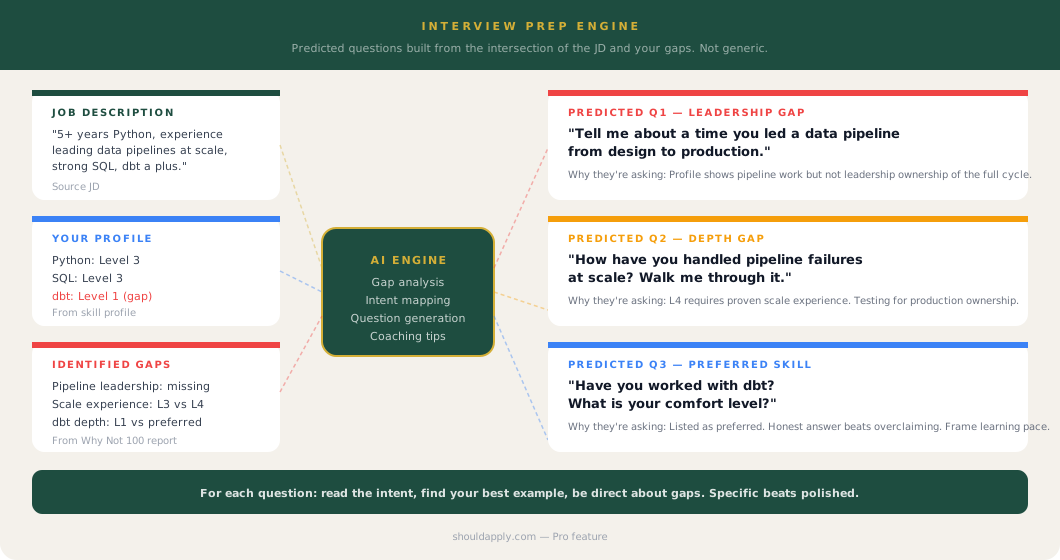
Generic interview question lists prepare you for the wrong interview. The prep engine generates predicted questions from the intersection of the job description and your specific gaps. You know what is coming before you walk in.
Why Generic Prep Lists Fail
Most interview prep follows the same pattern: find the "top 50 product manager interview questions," practice answering them, hope the right ones come up. The problem is that interviewers are not working from a generic list. They are looking at your resume, comparing it to their requirements, and probing the places where they see a gap or uncertainty.
A candidate with strong strategy experience but limited data analysis depth gets probed differently than a candidate with the opposite profile. A candidate applying for a role that requires "extensive pipeline leadership experience" but whose resume only shows individual pipeline work faces very specific questions. The prep engine builds from that specific intersection.
"Tell me about yourself. What is your greatest weakness? Where do you see yourself in five years." Memorized answers to questions that may not come up, while the actual probe points go uncovered.
"Your profile shows pipeline work but not ownership of the full cycle. This question is coming." Built from what the interviewer is actually concerned about, not from a general template.
Four Question Categories
Every predicted question is tagged with its category and includes an intent explanation: why a skilled interviewer would ask this, what they are trying to assess, and what a strong answer addresses.
Gap Questions
Directly target the gaps the engine identified in your profile. These are the questions interviewers ask when they see something in your resume that raises a concern.
"Tell me about a time you led a data pipeline from design to production." (Asked because your profile shows pipeline work but not ownership of the full cycle.)
Find a specific example from your experience that closes or reduces the gap. If you do not have one, be direct about your development plan in this area.
Depth Probes
Test whether your stated skill level holds up under pressure. These come from areas where you claim strength but the role needs you to operate at a higher level.
"Walk me through how you have handled a production pipeline failure at scale." (Testing whether Level 3 SQL depth extends into production ownership, which the role requires at Level 4.)
Prepare to go a level deeper than your standard answer. Have a specific example with scale, complexity, or ambiguity that demonstrates higher competency than your profile currently shows.
Preferred Skill Questions
Soft inquiries about skills listed as preferred rather than required. The stakes are lower, but honest answers build more trust than overclaiming.
"Have you worked with dbt? What is your comfort level with it?" (Listed as preferred. They are not expecting mastery, but they want to know where you actually are.)
Answer honestly and frame your learning pace as a strength. "I have not used dbt in production, but I picked up [similar tool] in two weeks on a project" is a better answer than a vague claim of familiarity.
Competency Questions
Behavioral questions tied to the specific competencies the role emphasizes. These are not gap-driven but signal-driven: the JD uses language that indicates the team cares about certain working styles.
"Describe a time you had to align stakeholders with competing priorities on a product decision." (From JD language emphasizing cross-functional influence and difficult tradeoffs.)
Use the STAR format but cut the setup short. Spend most of your answer on what you specifically did and what the outcome was. Hiring managers lose interest in long situation-setting.
The Prep Framework
For each predicted question, work through four steps. This takes about 10 minutes per question and produces better interview performance than hours of generic practice.
Read the intent explanation
Understand what the interviewer is actually trying to assess. The surface question is rarely the real question. A question about pipeline failures is assessing production ownership, not your ability to describe a problem.
Find your best example
Identify one specific experience from your work history that addresses the underlying concern. It does not need to be perfect. A relevant example told with specificity beats a polished answer that is vague.
Cut the setup, double the result
Most people spend too long on situation and task. Practice getting to your specific actions within 20 seconds. Spend the majority of your time on what you did and what happened as a result.
Prepare the gap version
If you do not have a strong example, do not deflect. Prepare a direct, honest answer: here is where I am, here is why I believe I can operate at the level this role needs, here is evidence of how quickly I develop in new areas.
The Gap Framing Rule
When an interviewer probes a gap directly, the worst response is evasion. The second worst is overclaiming. The best response is specific honesty paired with a forward frame.
"My direct dbt experience is limited to one project, but I built a comparable transformation layer in Spark and picked up the pattern in about a week. Based on that, I am confident I can reach productive depth in dbt within the first month." That answer is more persuasive than claiming familiarity you do not have, and it demonstrates exactly the quality the role needs: the ability to learn fast and be direct about where you are.
Go Deeper
Frequently Asked Questions
How does the engine know which questions to predict?
It analyzes the intersection of two things: the specific requirements in the job description, and the gaps in your profile relative to those requirements. A gap in pipeline leadership at scale produces a different question than a gap in a preferred tool. The questions are built from the actual delta, not from a generic interview question bank.
Are these the exact questions I will be asked?
No. The engine predicts the themes and angles interviewers are likely to probe based on what your profile shows relative to what the role needs. The exact phrasing will differ, but the underlying concern an interviewer is addressing will usually match. Treat them as prep areas, not scripts.
What if I score 90+ and have few gaps? Are there still questions?
Yes, but they shift in character. A strong-match candidate gets questions probing depth and ownership in the areas they claim strength in, rather than questions designed to expose gaps. The engine always generates prep content, but the focus changes based on your score profile.
Should I memorize my answers to these questions?
Memorization is the wrong goal. The prep framework works better: identify what concern each question is probing, find one concrete example from your experience that addresses it directly, and practice framing that example in 60-90 seconds. Specific examples beat polished delivery every time.
Is the Interview Prep Engine available on the free tier?
Interview prep is a Pro feature. Free users can see their score and top gaps. Pro users get the full predicted question set with intent explanations, category filtering, coaching tips, and the ability to regenerate questions if the JD or their profile changes.
Know what is coming before you walk in.
Score a job, get your gap breakdown, and unlock the predicted question set with full intent explanations. Pro feature, free to try.
Get Your Free Score